

As a freelancer, you enter the business world expecting agreements to be transparent, professional, and compliant with the law. Unfortunately, experience shows that international Business Process Outsourcing (BPO) providers and their corporate clients are increasingly misusing freelance contracts as a cover for social dumping and tax evasion.
How it Began: The Promise
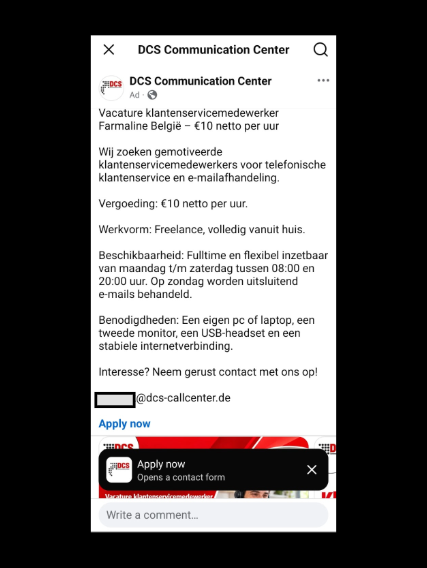
The operational pattern is highly consistent: targeted social media campaigns recruit multilingual remote workers for customer service projects targeting the Belgian market. As shown in the attached screenshot, the advertisements explicitly promise a fixed compensation: “€10 net per hour”. For a starting independent professional or a remote worker operating from abroad, this sounds like a straightforward and secure income stream.
The Fiscal Trap
However, the legal and fiscal reality is uncompromising: within a legitimate B2B agreement, it is technically and legally impossible to establish a “net” hourly rate. A freelancer invoices gross revenue. Tax authorities and social security institutions in the country where the freelancer physically operates (whether Germany, Greece, or Poland) do not recognize net rates for independent contractors.
The benefit of this setup lies exclusively with the hiring corporations. For them, the amount is indeed a fixed net rate: they pay a flat fee, contribute zero corporate social security taxes, avoid employer liabilities, and bypass standard labour protections. The freelancer receives the amount as gross revenue and is left to calculate and pay income tax and local social security contributions entirely out of pocket. Under the line, virtually nothing remains of the promised fee.
How it Ended: Control and Intimidation
Beyond the fiscal impossibility of the hourly rate, these projects exhibit all the classic markers of false self-employment (bogus self-employment). Remote workers are subjected to strict management control, including mandatory shift schedules (full-time availability between 08:00 and 20:00, Monday through Saturday) and mandatory hardware requirements. A clear employer-employee subordination exists.
When a freelancer attempts to hold the company to its contractual obligations—such as the agreed notice period upon termination—the predatory nature of the structure becomes clear. In this specific case, access to all operational systems was instantly blocked without warning via an informal WhatsApp message from a team leader. Corporate documentation, including the countersigned agreement, has been systematically withheld for months to obstruct regulatory checks. Demands for the legally owed notice payout were met with coercive settlement offers to cut the payment in half. When this manipulation was rejected, the company immediately issued aggressive legal threats regarding alleged “defamation” in an attempt to enforce silence.

Current Status
The silence has been broken. The illegal nature of this specific infrastructure and its deceptive recruitment campaigns are currently under formal investigation by competent regulatory authorities in multiple European jurisdictions, including the Belgian Federal Public Service Economy (Case File: NOT-2026-002070), the German Customs Authority (FKS), and the Polish Labor Inspectorate (PIP).
This case is actively ongoing, and strategic work continues behind the scenes to address this cross-border exploitation. Independent professionals are strongly urged to remain vigilant: if a B2B contract promises a “net” wage while demanding the compliance of a traditional employee, protect your business and refuse to sign.
LINKEDIN Page